
One partnership turned an opportunity into a lasting career
By / Natalie Bruckner
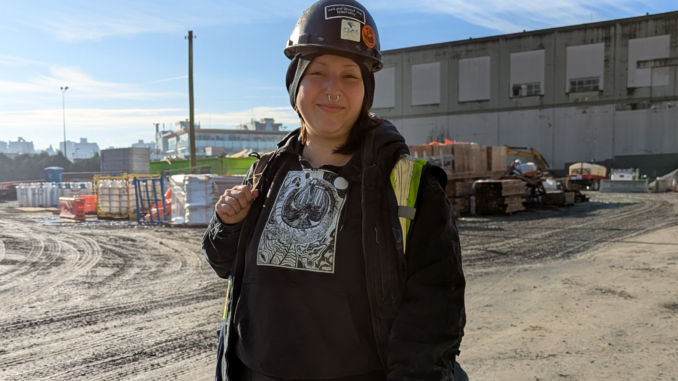
It was pure chance that Savannah Snakeskin happened upon the sheet metal trade, and she couldn’t be happier. It’s a familiar story: many people never know about what is often considered one of the most overlooked trades, until an opportunity appears.
“I moved back to Vancouver in the hopes of getting into a heavy equipment operator [HEO] course at the Squamish Nation Training and Trades Centre,” explains Snakeskin. “Unfortunately, or fortunately, depending on how you look at it, the HEO course was already full, so I ended up going in a different direction. There was space in a women’s try-a-trade program in which we were able to sample six different trades, one of which was sheet metal.”
The program included a one-week Discovery to Sheet Metal course held at the Centre by Local 280 Sheet Metal Workers’ Training Centre in May 2025, which provided hands-on experience and real exposure to the work.
“The Squamish Nation had reached out to us and asked if we wanted to do a one-week introduction to sheet metal, and we said absolutely,” explains Jake LeBlanc, head instructor at the Sheet Metal Workers’ Training Center Society. “We had done programs like this before with them, so we already had a good idea of how to approach it. We loaded up equipment and spent a full week with the participants.”
LeBlanc says that in the first discovery week of 2025, there were five participants in the women-only group, including Snakeskin, who he says “immediately stood out. She was a natural: motivated, focused, and very hands-on.”
He explains that over the week Snakeskin showed a real aptitude for sheet metal. “She didn’t just follow instructions, she took a simple box project, modified the design on her own, and created a stackable version without being asked. That kind of thinking tells you someone really understands what they’re doing. By the end of the week, I encouraged her to seriously consider sheet metal. She decided to give it a try, and we connected her with a union contractor.”
LeBlanc had reached out to Boston Sheet Metal to see if there was an opening for an apprentice. “Jake knew I was already interested in supporting Indigenous apprentices and he was very clear with me and said, ‘You don’t want to let this one go,’” explains Peter Sové, project manager at Boston Sheet Metal.
Sové initially placed Snakeskin on the Sparrow House rental tower in Vancouver before moving her to the San̓ak̓w project, a development project on 10.5-acres of Squamish Nation land located on Kits Point adjacent to Vanier Park.
“Moving her from one project to another was very intentional. I wanted to see how she performed under different foremen and project managers. It gives a much clearer picture of how someone adapts to different team dynamics. The crew really wanted her back. That tells you a lot,” Sové says.
He adds that Snakeskin shows remarkable promise. “Honestly, most apprentices don’t stand out to project managers, and that’s usually fine, but Savannah is so interested in the work, reliable, and has such a great attitude. This is a well-paid trade, and sometimes younger apprentices don’t feel the immediate pressure to be there every day, but Savannah doesn’t just show up; she’s eager, engaged, and wants to be part of the team.”
As a result, Sové encouraged the foremen to give her more responsibility. “Several have already said they could see her running her own job one day. There’s an energy and presence she brings that matters more at this stage than technical skill.”
For Snakeskin, the transition from school to a work practicum was a welcome change of pace. “I decided on sheet metal early on in my program, and by the end of it I was chomping at the bit to get some hands-on experience. Working on jobsites, I take pride in knowing that I am helping build something of quality for whoever ends up living in the towers I help construct,” she says.
Snakeskin’s journey is a great example of how the Local 280 training centre, SMACNA member Boston Sheet Metal, and the Squamish Nation support apprentices. “These partnerships are critical,” says LeBlanc. “As a training centre, we sit in the middle, between workers and contractors, and our job is to support both. We create training that prepares people for real job sites, and we stay in constant communication with employers about what they need. These outreach programs benefit everyone. Communities gain access to opportunities, contractors gain skilled workers, and individuals discover career paths they might never have considered. That’s what this work is really about: opening doors and giving people a chance to see what’s possible.”
LeBlanc notes that interest in these programs has grown over the years as robust awareness efforts have reached a wider audience. “In our current first-year class of 2026, participation is more diverse than it has been in the past. Fifteen years ago, the classroom looked very different. Challenges like bias still exist, but they’re slowly declining. What many students face is the need to prove themselves and adapt to expectations in traditionally male-dominated environments. From an employer’s perspective, however, it comes down to productivity: Can you do the job safely and contribute? If the answer is yes, there’s a place for you.”
Newcomers face a number of barriers when starting out in Canada, and language is often at the top of the list. LeBlanc recalls one course he held when a student’s hand drafting immediately impressed him. “I asked him where he was from and what he did there. He said the Philippines and worked for City Hall as a civil engineer. Then another student piped up: ‘I’m from Taiwan. I’m an electrical engineer.’ Another added, ‘I’m from China. I’m a mechanical engineer.’ Suddenly, I had three engineers in my class, patiently listening as I explained how to add a half and a quarter. I remember thinking, What are you guys doing here? They told me their degrees weren’t recognized in Canada. They needed to learn English, so they decided to become sheet metal workers.”
That’s when LeBlanc realized the Centre could reach newcomers by advertising in their first languages. “They already have the skills; we just need to connect them with ESL training and improve their English while they’re working. I’m all about finding solutions to every problem.”
Breaking down barriers and raising awareness is a full-time job, as both LeBlanc and Sové attest, but it is worth it for the future health of the industry, as shown by Snakeskin.
“My advice for anyone curious about the sheet metal trade is to try it. The pre-apprenticeship is a great way to get paid and gain hands-on experience to see if you could imagine yourself in this trade long term. One learning curve I’ve experienced is my perfectionism. I definitely struggle if I don’t get things right away, but all of the other apprentices and journeymen I’ve worked with have been great teachers: patient, encouraging, and supportive. I’m thankful that I’ve been given space and time to learn without being perfect right out of the gate.” ■
Natalie is an award-winning writer who has worked in the United Kingdom, Germany, Spain, the United States, and Canada. She has more than 23 years experience as a journalist, editor, and brand builder, specializing in construction and transportation. When she’s not writing, you will likely find her snowboarding, mountain biking, or climbing mountains with her rescue dog.