
By Natalie Bruckner • Photos courtesy of Crosstown Metal Industries
The Annacis Island Wastewater Treatment Plant (WWTP) in Delta, BC, serves as a vital part of Metro Vancouver’s infrastructure, treating approximately 175 billion litres of wastewater annually. Originally built in 1975, the plant stands as the largest secondary treatment facility in the region, serving over one million residents across 14 municipalities.
As Metro Vancouver’s population has continued to grow, it became clear that the existing facility was nearing its limits. To address this, the expansion project was launched, aiming to accommodate an additional 250,000 people, enhance seismic safety, and prepare the plant for future climate challenges.
One major component of this ambitious upgrade is Crosstown Metal Industries Ltd.’s work. Crosstown is no stranger to the Annacis Island WWTP; in fact, it has played an integral role in the plant’s development for more than three decades. Their involvement in this latest major refurbishment focused on the replacement and installation of ductwork—an intricate task made more challenging by the operational constraints of the facility.
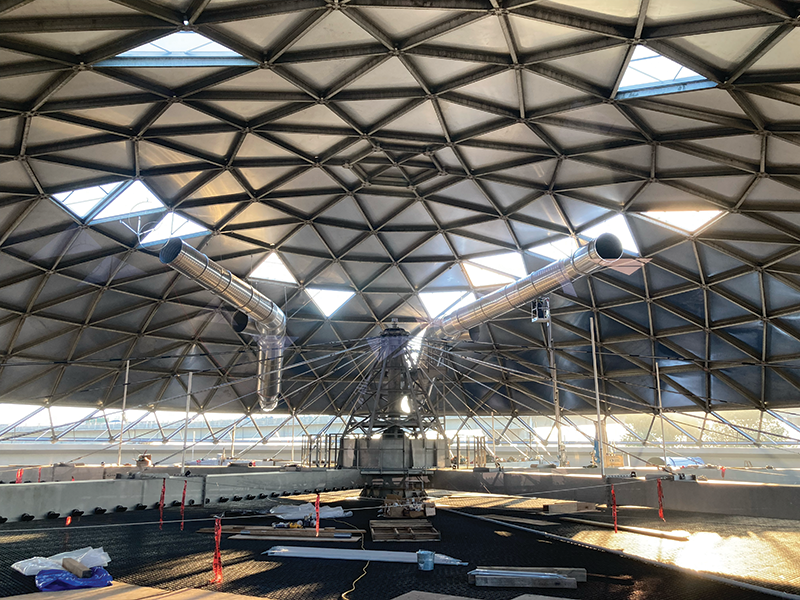
The company previously worked on the plant’s ductwork installation during a major upgrade back in 1994, so when the current expansion began, they were selected due to their deep familiarity with the project. “The original installation used aluminum ducting, which over time needed to be replaced with 316 stainless steel [low carbon], a stronger and more corrosion-resistant material,” explains Dave Kisser, project coordinator at Crosstown.
The decision to upgrade to stainless steel was indeed crucial, given the plant’s exposure to moisture and harsh chemicals. The material’s durability and resistance to corrosion make it ideal for an environment like this, ensuring long-term reliability in a critical infrastructure project.
One of the major hurdles faced during the project was maintaining continuous operation at the WWTP. With millions relying on the plant for wastewater treatment, shutting down sections of the facility was not an option.

“The plant had to remain operational throughout construction,” Kisser says. “We started work on the first trickling filter [a type of wastewater treatment technology that uses microorganisms attached to a medium to remove organic matter] back in 2019, and the last one was completed in 2024. There’s still one portion left, and we’ll be returning to do additional work in 2026.”
Given the operational constraints, Crosstown’s team had to work within very narrow timeframes, with limited windows for installation. “They could only shut down one trickling filter at a time, and only during the drier months,” Kisser explains. “That meant our work window was essentially from May through the end of September. Though we had ample time for fabrication, the installation schedule was tight so once our window opened, we had to move fast.”
The challenges weren’t limited to time constraints. The COVID-19 pandemic added further complexity to the project, disrupting supply chains and causing delays in obtaining critical components. “One of the biggest delays was with the special dampers we needed—they were held up for about four months. The manufacturer couldn’t source the resin needed for the gaskets. It’s amazing how something so small can cause such a big delay,” Kisser reflects.
Despite these setbacks, Crosstown’s team relied on their experience and pre-planning to keep their portion of the project on track.
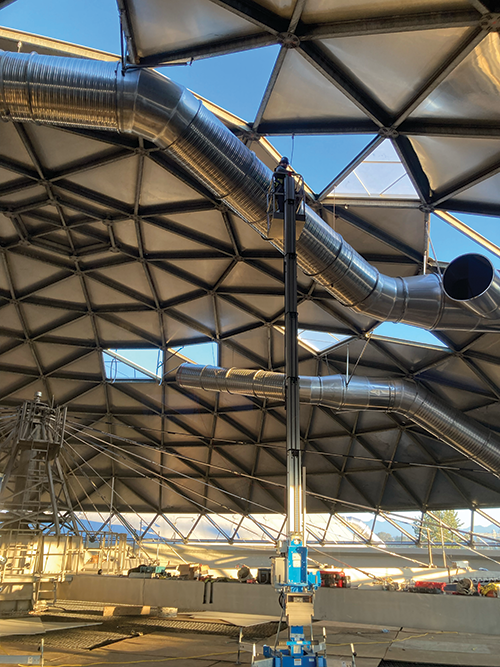
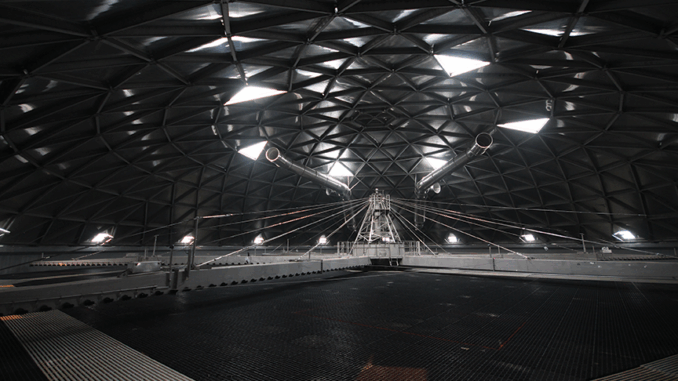
The Annacis Island WWTP’s design also posed unique challenges for Crosstown’s ductwork installation. “What made it particularly challenging was that all the ductwork had to be suspended from the geodesic domes covering the tanks,” Kisser explains. “Nothing was level or consistent, which made the installation tricky.”
To overcome these obstacles, Crosstown’s team provided CAD drawings for the entire ventilation system. “This allowed us to layout and install the hanger system when the geodesic dome was on the ground while having an unobstructed area to work with,” Kisser says. “Having this done earlier in the schedule also lessened the ducting installation time once the dome was reattached to the tanks.”
The Crosstown team also designed custom engineered 316 stainless steel hangers for the ductwork to be suspended from the domes, ensuring that they met both seismic requirements and installation constraint of the project. Inside the geodesic domes, 60-inch roundup ductwork made from 22-gauge spiral pipe was used due to weight restrictions. “We used Accu flanges inside the dome strictly because of weight restrictions,” Kisser explains.
Outside the tanks, heavier 18-gauge welded flanged ductwork was necessary to accommodate the larger fittings and external stresses.
The next challenge was the installation. “We initially thought we’d need scaffolding, but ended up using lightweight Genie lifts instead,” Kisser says. “The filter media inside the trickling filter couldn’t support heavy equipment, so the general contractor built a plywood floor over the filter media, allowing us to use smaller 45-foot man bucket lifts to install the ductwork.”
The tight timelines, logistical challenges, and collaborative nature of the project made it a unique experience for everyone involved. “It was a well-coordinated effort, but the tight timeline and logistical challenges kept things interesting,” Kisser says. He credits both Pat Siebens and Perry Dicks from Crosstown for their exceptional work.
“The teamwork between everyone involved including the other subcontractors and general contractor was exceptional,” he says. “It was great working with a team where everyone was dedicated and working together toward the same goal.”
As the project nears its final phase, slated for completion in 2026, Crosstown continues to play a vital role in ensuring the Annacis Island WWTP can meet the growing demands of Metro Vancouver. “When my kids were younger, we’d drive over the Alex Fraser Bridge and pass those big domes, and they’d say, ‘Look, there’s Daddy’s work,’” Kisser reflects. “Now that they’re grown, they still chuckle when we pass by, and it’s a nice feeling seeing something so impressive looking, knowing that you were a part of it. It’s a reminder of the lasting impact of the work we do.” ■
After nearly two decades of persistent advocacy, the British Columbia Construction Association (BCCA) and fellow industry partners have brought the construction sector one step closer to seeing prompt payment legislation enacted in British Columbia.
The pace of progress elsewhere makes BC’s delay all the more striking. Ontario introduced its prompt payment legislation in 2019, followed by Alberta and Saskatchewan in 2022, with New Brunswick following suit in 2023. In 2025, Manitoba also established a prompt payment regime, and Quebec is moving toward similar measures, reflecting a growing nationwide recognition of the need for payment certainty in construction. Yet in all this time, as BCCA president Chris Atchison points out, BC has remained “willfully and woefully behind.”
For those in the sheet metal industry in BC, prompt payment would mean contractors can submit timely invoices and receive payment regularly throughout a project, rather than waiting months to get paid in full. Under the proposed legislation, owners are required to pay contractors within 28 days of receiving a proper invoice, unless a non-payment notice is issued within 14 days to explain any dispute or delay.
“Some owners or contractors who already see timely payment may see this as unnecessary or disruptive,” Atchison says. “But we know from our annual industry survey that 91 percent of trades and general contractors are paid late. The legislation is aimed to set a benchmark and protect those left vulnerable under the current system. We want to set a standard that allows everyone to thrive.”
Despite recent concerns that progress has stalled, Atchison assures it is anything but. In fact, the BCCA has been pressing even harder. “In April 2025, during Construction and Skilled Trades Month, the province committed to assigning a team in the attorney general’s office to review our recommendations and to bring forward draft legislation, with the intent to table it in the fall sitting,” he says. “It is now in the hands of legislative drafters, hence the silence, and we’re optimistic it will be introduced and passed, and then followed by the drafting of regulations.”
As with any legislation, the process has been slow and arduous. When Atchison joined the BCCA eight years ago, prompt payment was a significant problem but still a low-priority advocacy issue. “Over time, however, more boards, including our regional associations, SMACNA-BC, the BC Building Trades, and electrical and mechanical contractors, formed a ‘consortium of the willing’ to push for it,” he says.
Though prompt payment has never been what Atchison calls a “sexy” political topic, the successive BC governments began to take note. Another major step occurred two years ago when Attorney General Niki Sharma engaged with the issue, studying BCCA’s cross-jurisdictional research and reviewing the recommendations.
“She has done her homework on this, not just taking our word for it, but conducting her own research,” Atchison notes.
A surprising yet positive factor has been the recent focus by federal and provincial leaders on removing internal trade barriers to strengthen the Canadian economy. This push for harmonization has further fueled momentum for prompt payment legislation in BC.
“It is up to BC to become more aligned, not more alienated, and to be more aligned means adopting a form of payment certainty for the entire supply chain to remain competitive with what other jurisdictions are doing and with what the federal government has done,” Atchison says. “This also supports interprovincial trade harmonization. If BC does not align, we risk losing contractors to provinces where their livelihoods are better protected.”
Given the scale of BC’s construction industry, estimated at around $330 billion in active projects and employing hundreds of thousands, the current lack of payment certainty is, as Atchison puts it, “unacceptable.”
“This isn’t just about when contractors get paid; sometimes it is if they don’t get paid at all,” he adds. “Being paid late can be just as damaging as not being paid because companies still accrue debt, carry lines of credit, and pay their workers. Government is a major investor in infrastructure, involving large general and trade contractors as well as smaller firms and independent operators. Without prompt payment protections, we put them all at risk. I have told the government this for years—if you are investing in building BC, you cannot be enabling businesses to go out of business.”
While BCCA will continue to advocate persistently, and Atchison credits SMACNA for its engagement, he advises the sector to prepare for what comes next.
“People can go online to promptpayment.ca and petition, and we read all feedback,” he says. “But more importantly, SMACNA members should continue educating themselves on what this new payment framework will look like and the transition toward a system that fully embraces payment certainty.
“As an industry, we are known to adapt. We did it through COVID, and now we need to adapt to a system that has existed in the UK for decades and Ontario for nearly a decade. We need to adopt industry best practices and develop our own version of payment certainty legislation instead of allowing continued erosion of confidence in BC’s construction sector.” ■